Your Service Manual Should be an App
Claude and the art of motorcycle maintenance.
The Great Escape
Motorcycles are wonderful things, but if asked to explain why, a motorcyclist may sound as if they’re insulting the hobby. That’s because motorcycles are recipients of the IKEA effect without the front-loading: you get your installments of working on the thing spread out over the years you own one. To the practical car owner, this may sound miserable. However, a typical motorcycle’s maintenance is not as much of a challenge as that of a car. For one, a motorcycle is far smaller, and the parts weigh nothing. You usually won’t need a hoist, or help from a friend. For two, motorcycle parts are almost invariably easier to get to than those of a car. You don’t have to crawl under the thing on a wheeled stretcher, and you don’t have to dig around in a crowded engine compartment with a flashlight. No interior panels, either!
That said, Harley owners are (according to the service manual) replacing spark plugs every 10,000 miles. When’s the last time you had to do that on your Corolla?
Motorcycles are largely big babies that need attention and fiddling and the utmost care. Unless they’re made by Honda.
On Any Sunday
Because the barrier to maintenance is low, and because it’s mostly small and obvious jobs from the beginning, owning a motorcycle turns into a schedule for your free time, rather than a problem-causing machine you drag to the dealer after something unexpected happens. Like most car owners do.
So your Sundays become motorcycle days, and because you don’t want to become another statistical testament to the absurdity of the hobby, you spend some of that day making sure that baby is happy before and after riding. You probably even buy your model year’s service manual.
I think you should!
But, to be honest, the first thing I reach for (as a zoomer) is Google. Or LLMs, which often don’t actually have any grounding on this. For instance, if you ask your LLM right now what torque to put on an arbitrarily selected bolt on your bike, it will just have to guess. Its guess may be good enough; after all, that’s usually what most people do when they’re putting the bolts back on. Google will be worse, because it will just have shtuyot from people discussing my machine in terminology I don’t understand, or discussing things adjacent to the question. I don’t really like that.
So, you could grab a PDF to use as grounding, and ask for citations to check which page it got what info from. But honestly, there’s a limited number of questions and answers we can get from the manuals, and from online. So we could save tokens here by guessing ahead of time, writing guides for all of it, and making tables for all the values.
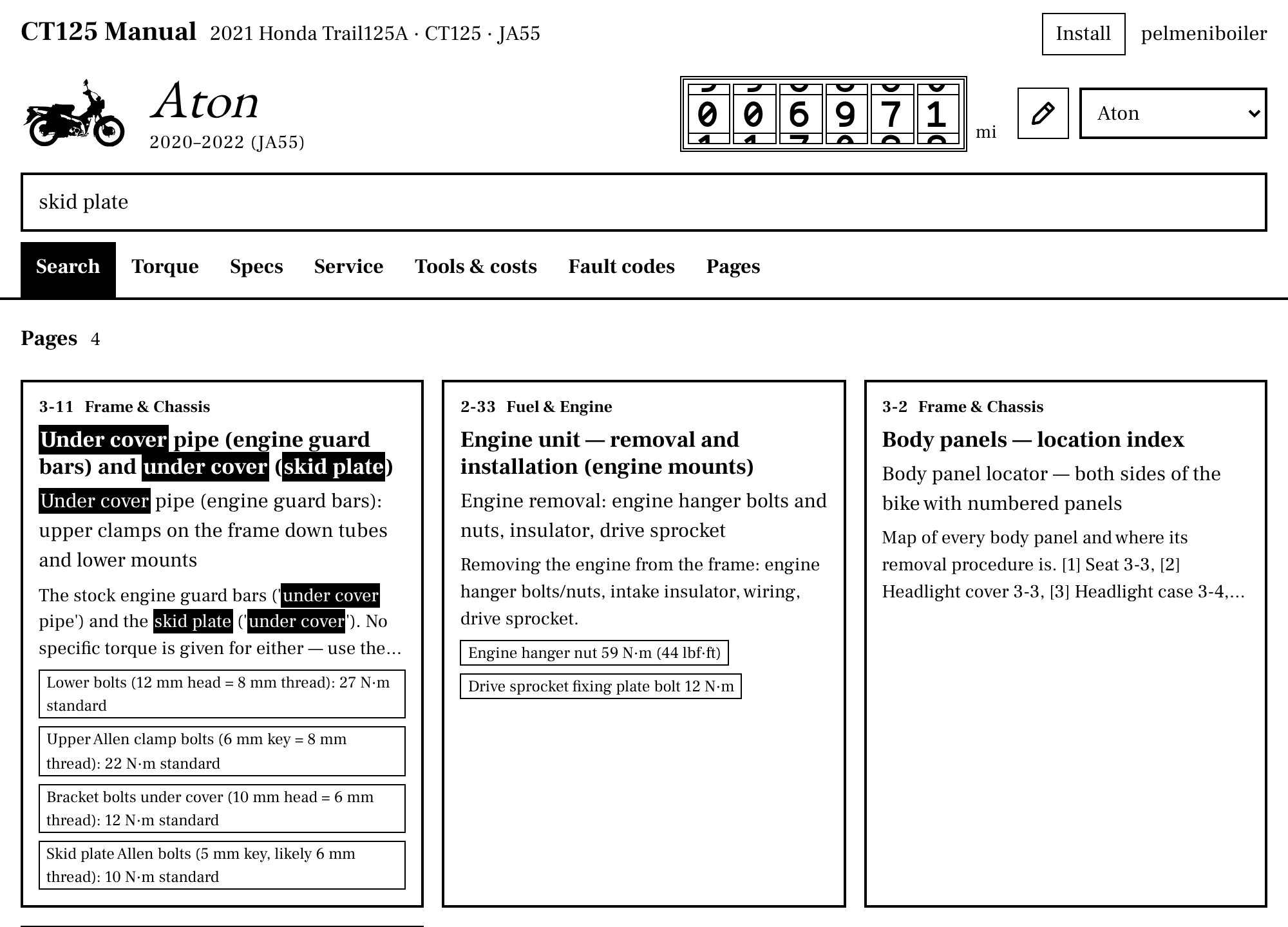
PDFs are annoying to search, too. Mine is a scan: pictures of pages, with no text behind them at all, so ⌘F finds nothing. Even a PDF with real text only finds the exact letters you typed, in Honda’s words. Type “skid plate” and you get nothing, because Honda calls it the “under cover”. The app knows both names, and dozens more like them. It searches the torque tables, specs, fault codes, guides and every page’s summary at once, ranks what it finds, and shows you the number itself rather than the page it’s hiding on. Every result still names its page, so you can check it.
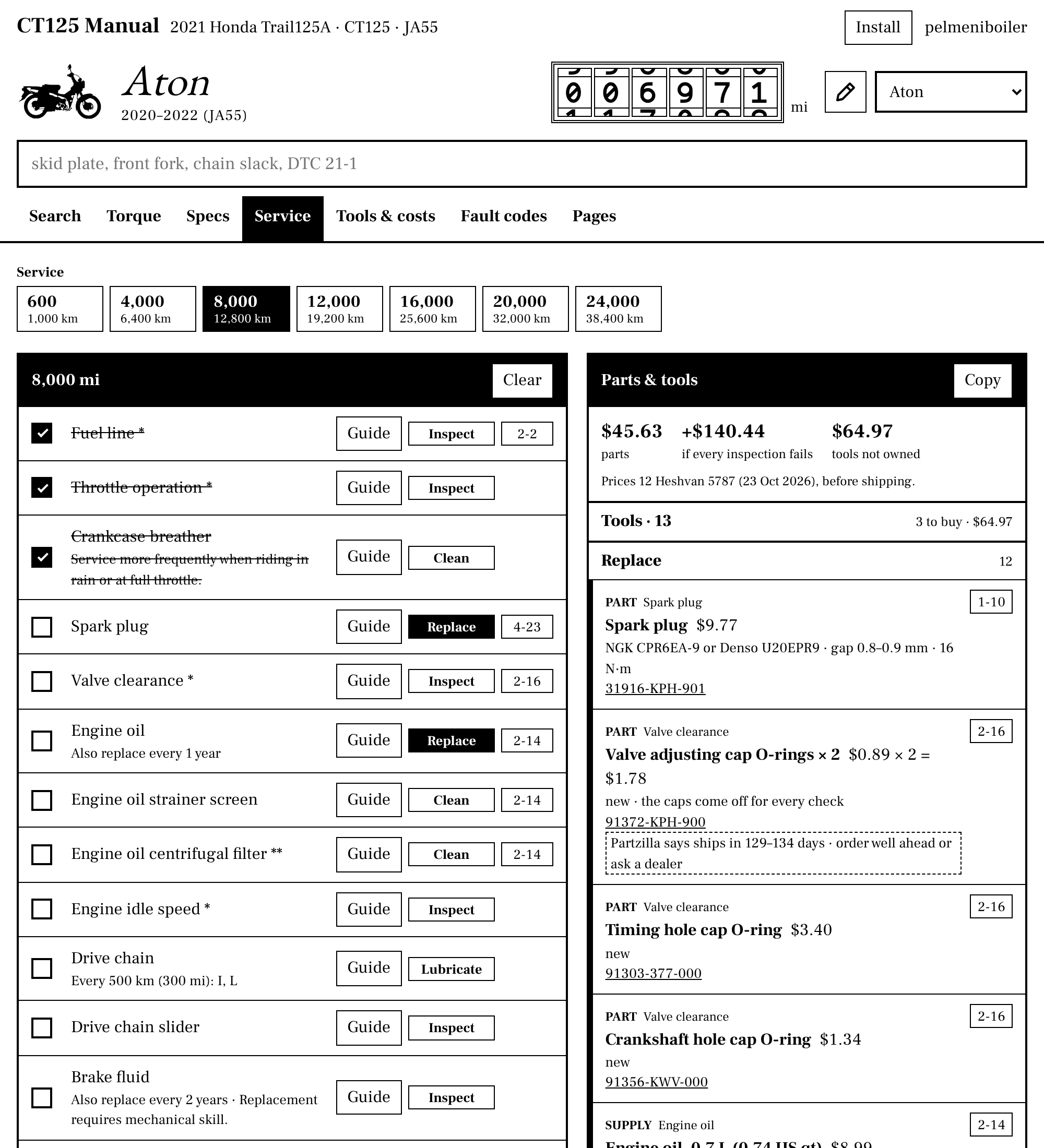
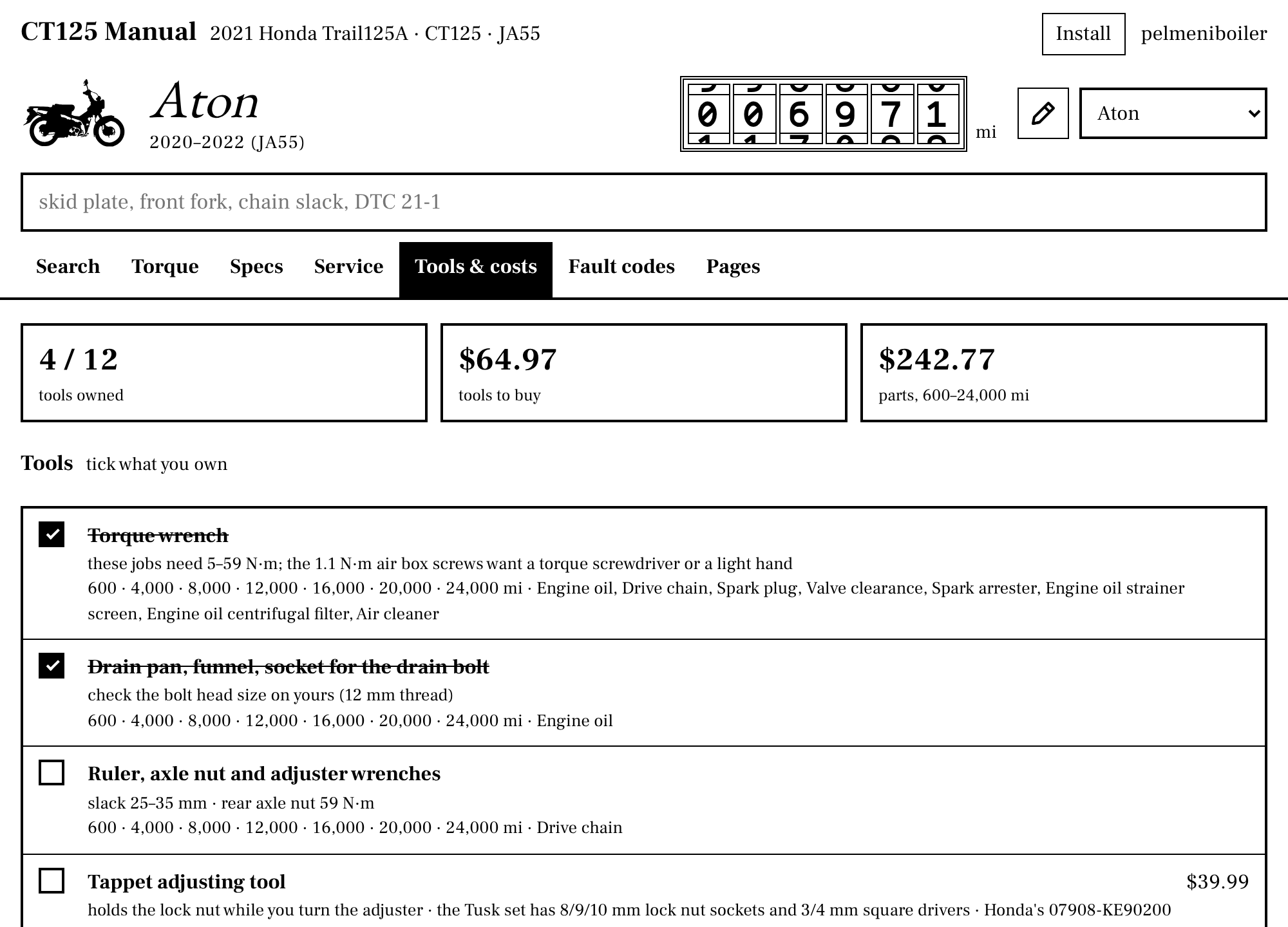
Plus, it’s annoying how I have to look through the service manual, type in part numbers and find the parts I need for the next interval. Let’s know the cost ahead of time, and have links to them!
When people were theorizing about what computers would bring to the world, this was exactly what they imagined. Documents and books would have hyperlinks, be searchable, and interact with further documentation in a way that’s impossible for the paper copy. So why on earth should the instructions for keeping my precious motorcycle running be difficult to use?
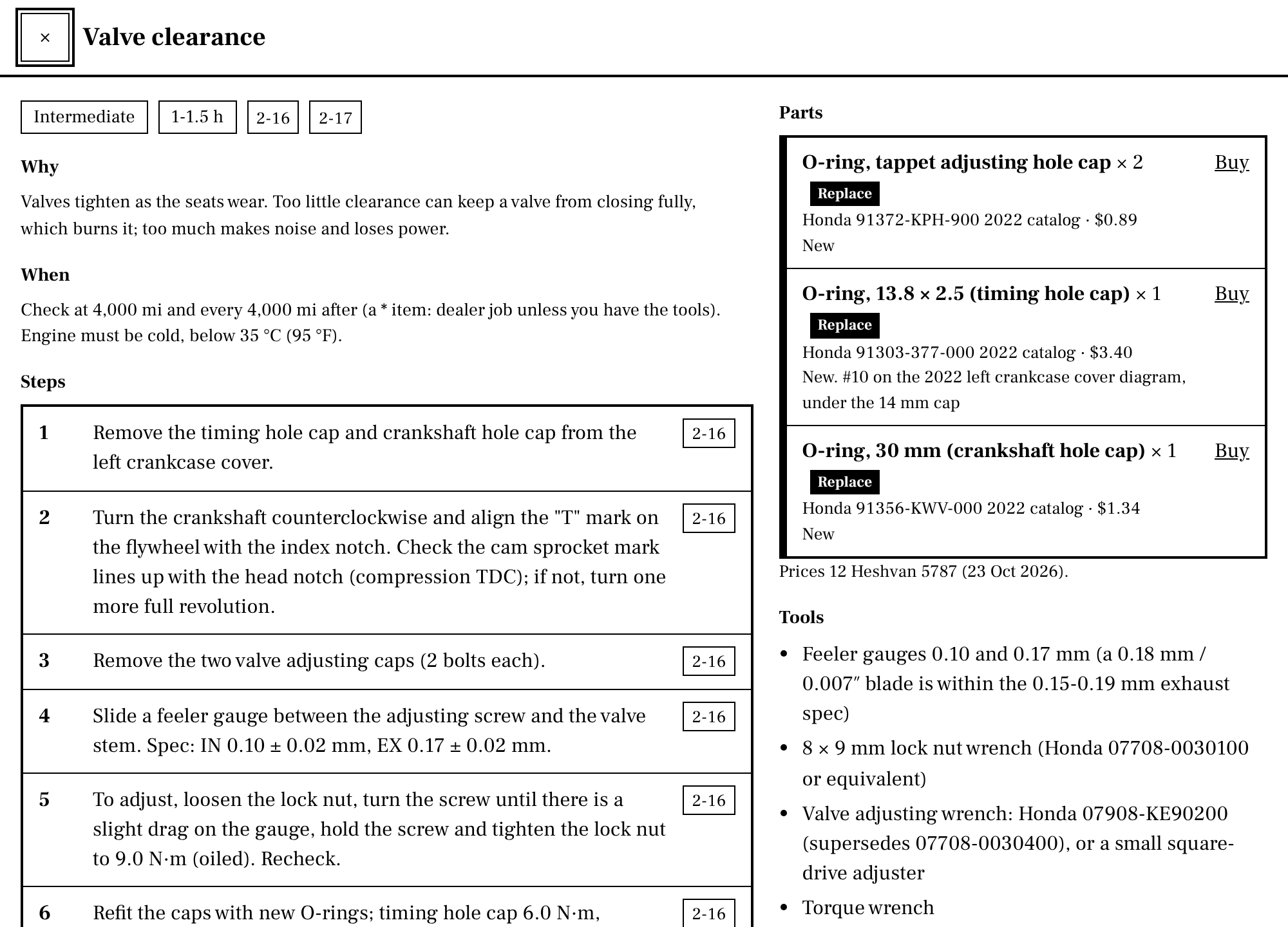
Maybe this could be solved in other ways, but this is kind of what works best for me. Now when I ask Claude, he can give me links to the specific thing I need to read, like the valve clearance guide or the axle nut torques, or synthesize this with information that isn’t in the book. Imagine if I asked Claude for advice on how to swap in a custom big-bore that leaves enough compression on the table to drink 87? He’d be a lot more help with this. Oh, and you’re supposed to use the Owner’s Manual, the Common Service Manual and the Parts Catalog as supplements to your Service Manual. Imagine juggling all those pages on your messy workbench!
Super Cub
So, if you want to try this, and you happen to own a Honda CT125 / Trail 125 / Hunter Cub of any model year, please check out 🏍 ct125.manual. You can track your mileage, plan for upcoming maintenance, read guides, and load your own PDF of the manual. I’m not sure if Honda wants me to include their manual in this, but it seems they don’t mind the forum sharing it, so unless anyone from Honda reaches out to clarify, I assume they’re okay with you grabbing a PDF from there for your personal use.
What about my bike?
If you don’t have a CT125, buy one. Once you’ve done that, and if you want one of these interactive manual explorers for a different bike, point your LLM at my 🏍 ct125.manual, give it a PDF manual, or manuals, for your bike (the Kawasaki KLR 650 needs the Clymer manual, the KLR 600 manual and the 650 supplement, for instance), and have it make one for yours.
